2025 marked the launch of something that had been part of Atadiat’s goals since its earliest days: the training division. I launched a project called “Atademy,” short for “Atadiat Academy.” With this addition, Atadiat now consists of: the blog, the engineering and consultation services, and the training and education division.

During the year, I contributed by teaching the majority of the Embedded Systems course at the University of Damascus in the Faculty of Mechanical and Electrical Engineering, in the Department of Computer and Automation Engineering. Another educational project was preparing the content for the Embedded Systems course at a Saudi university, in collaboration with the course instructor. During this project, 14 lectures were completed, covering both the lectures and lab sections.

The first course within the Atademy project was completed, and I chose its topic to fall under general skills: the skill of designing printed circuit boards, which is essential for any embedded systems engineer. I decided to offer the course in Arabic due to the scarcity of similar courses in the Arabic language. I selected one of the most important PCB design software programs and designed the course to be comprehensive, covering all stages of PCB development—from schematic drawing and component selection to designing the PCB layout and ensuring its manufacturability at PCB manufacturing facilities.
I made sure this course was executed with the highest level of professionalism, including providing a website using the Moodle system to track progress and access recordings that were produced and recorded professionally.
Atadiat Academy, specializing in training content—both in-person and recorded—is currently launched in Arabic. Its goal is to deliver technical knowledge in the field of embedded systems and electronics to business owners who want to train their employees, as well as to students and enthusiasts who speak Arabic (for now).
PCB Design Course Using KiCAD
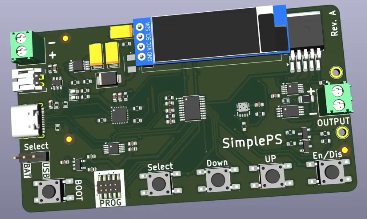
The first course was on electronic circuit design using KiCAD. This course contains the distilled experience of over ten years in designing and manufacturing dozens of electronic circuits of varying complexity. The course does not require prior experience, but it also avoids focusing in a boring way on the basics, instead teaching fundamentals naturally through the presentation of information and practical exercises.
The primary goal of the course is to equip those entering the electronics design and manufacturing market with the necessary skills. The secondary goal is to help those transitioning from Autodesk Eagle or Altium, to the increasingly popular and widely used KiCAD. The course includes a practical training circuit design, where each trainee is required to design its PCB, which is reviewed by the instructor before awarding the course certificate, verified with a code via the website.

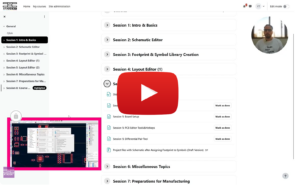
The course consists of 12 hours of recorded content, divided according to topics and sessions, available on a website for tracking progress and accessing the material. The recordings are in Modern Standard Arabic and not in a local dialect.
The course covers the following topics:
- Fundamental concepts in the stages of developing an electronic circuit leading up to the PCB
- Explanation of the circuit developed using a demo circuit during the schematic and PCB lessons
- Efficient part Selection with suitable pricing and assembly compatibility via JLCPCB.
- Theoretical schematics: Single Sheet & Multi-Sheet Schematic
- Creating symbols and footprints
- Electrical Rules Check (ERC)
- Linking symbols to footprints
- General PCB concepts
- Successful component placement
- Design tools in the PCB editor
- Auto-routing
- Overview of AI tools
- Details of PCB manufacturing and PCB assembly orders through JLCPCB
- General PCB design rules (Rules of Thumb)

Lecture: “Working as an Embedded Systems Engineer”
A few weeks after publishing the Atadiat 2024 report, I was kindly contacted by Eng. Ammar Al-Kurd, a lecturer at the University of Science and Technology in Yemen. He invited me to give a lecture to final-year students explaining the fields and requirements of working in the embedded systems job market, including remote work opportunities.
I prepared a lecture in which I discussed both modern and traditional trends in the embedded systems market. The lecture is recorded on YouTube, and the slides are also available. It covered the following topics:
- Tools and skills needed in the field (PCB design – embedded programming – IoT – embedded machine learning and algorithms – embedded Linux – robotics)
- An overview of job opportunities in companies
- Freelancing opportunities
- Future trends in job opportunities


University Course: Embedded Systems
This course was taught in the second semester of the academic year 2024–2025 for fourth-year students in the Department of Computer and Automation Engineering. It was an important experience for me, since it was with students from the same department I graduated from about 11 years ago, and I returned to teach after more than a decade of experience all within the field of this subject—embedded systems.
I put effort into benefiting from several previous teaching experiences I had gained—whether through short courses, workshops, or lab instruction during my master’s studies in Turkey—and applied them in teaching this course.
This was my first experience delivering the lectures of a university course. Although there is some debate regarding the eligibility of someone with a master’s degree, rather than a PhD, to teach lectures of a university course, it is unquestionably true that many universities allow engineers to partially or fully teach certain subjects where hands-on experience is a key factor in the success of the course. I learned many important lessons during this experience, which I will share with the reader.
I will share the lessons and tips I have learn during the preparation and teaching the course in a separate article.
Creating Embedded Systems Course Content for a Saudi University Using ESP32
Over the course of three months after I finished my first university course, I developed content for 14 lectures, including lab materials, in collaboration with the course instructor at a Saudi university. The instructor specified the topics and asked to use the ESP32. It was a good experience, as the completed slides were well received by the instructor, and I hardly needed to make any revisions. I benefited from my experience teaching the Embedded Systems course at the University of Damascus in proposing realistic and suitable content for the students. I frequently used the wokwi.com simulator to demonstrate practical applications using Arduino, which was the first time I had used it.
This was the first course I completed using the ESP32, coincidentally coming just a few months after using the STM32 in another course. I found, from the instructor’s perspective, that the ESP32 has complexities in its Reference Manual and SDK (ESP-IDF), which makes me reluctant to recommend using this chip in similar university courses. Additionally, there is a complete lack of academic references for the ESP32. The extensive details required for some of its peripherals, in my opinion, make it less suitable for use in courses like this.
Publishing an Article in Elektor Magazine
Last year, I read the book Test-Driven Development for Embedded C by James Grenning, which is considered the first book to discuss the methodology of developing embedded software using tests, commonly known as TDD. Since I could not find many concise and comprehensive references on this topic, I decided to write a complete summary article on TDD and published it in the well-known German magazine Elektor.

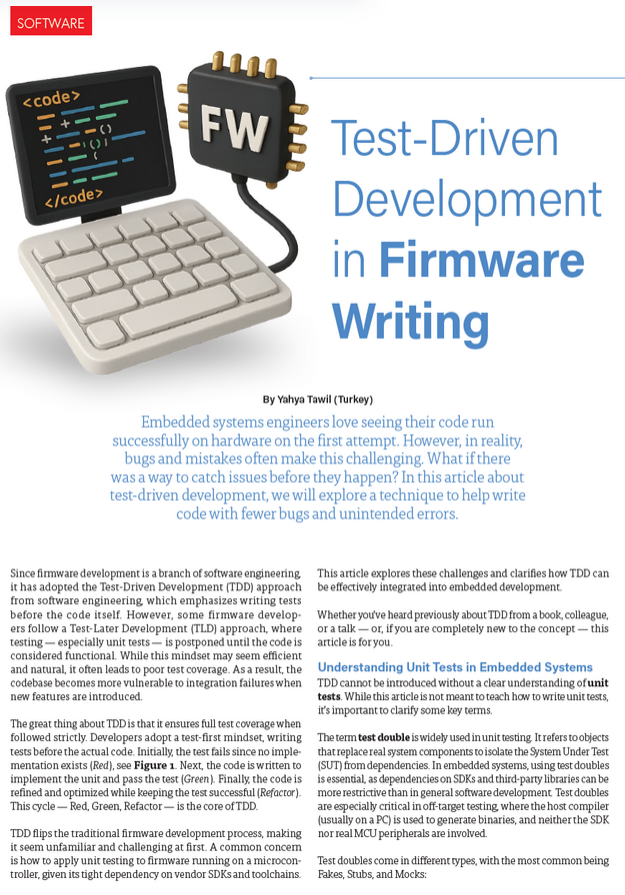
The article included an introduction to the concept, along with a simple practical example of writing a program to adjust a digital resistor value based on an input voltage and the desired output, using the TDD methodology. This was meant to demonstrate the applicability of TDD in embedded systems projects. I also discussed the main benefits, potential objections, and addressed them in the article. Additionally, the article included examples of using TDD in projects and companies as referenced by the developer community.


